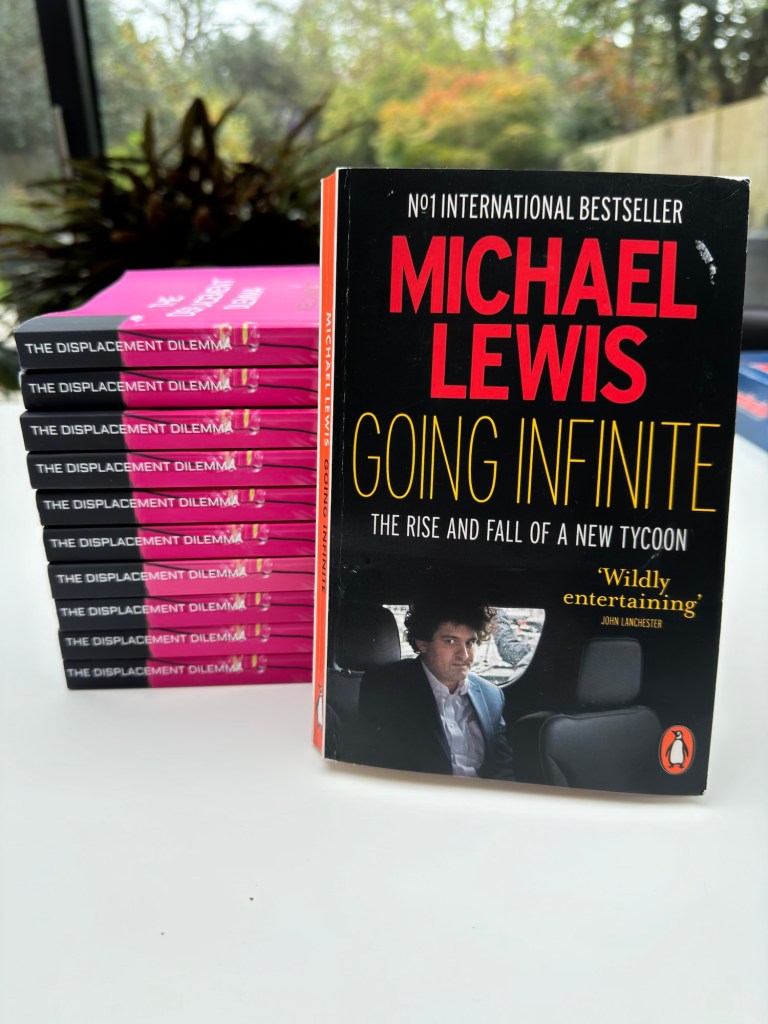
Michael Lewis has long been celebrated for his ability to transform complex financial narratives into gripping, accessible stories. His works, such as “Liar’s Poker,” “The Big Short,” and “Flash Boys,” have set a high standard in financial journalism. In “Going Infinite: The Rise and Fall of a New Tycoon,” Lewis turns his attention to the meteoric ascent and dramatic collapse of Sam Bankman-Fried, the founder of the cryptocurrency exchange FTX.
“Going Infinite” chronicles Bankman-Fried’s journey from a promising MIT graduate to a billionaire crypto magnate, and ultimately, to a figure embroiled in one of the most significant financial scandals of recent times. Lewis delves into Bankman-Fried’s early career at Jane Street Capital, his venture into the world of cryptocurrencies with Alameda Research, and the rapid growth of FTX. The narrative captures the shady allure of the crypto boom and the subsequent unraveling of FTX, leading to its bankruptcy and Bankman-Fried’s legal troubles.
Lewis’s storytelling prowess is evident as he navigates the intricate world of cryptocurrencies, making it comprehensible and engaging for readers. He provides insights into Bankman-Fried’s personality such as his unconventional demeanour, commitment to “effective altruism”, and the chaotic management style that characterised his enterprises. The book offers a window into the high-stakes environment of crypto trading and the ethical ambiguities that often accompany rapid financial success.
However, “Going Infinite” has faced criticism for its portrayal of Bankman-Fried. Some reviewers argue that Lewis’s close access to his subject may have led to a narrative that is overly sympathetic, potentially overlooking red flags and failing to critically assess the actions leading to FTX’s downfall. The New York Times noted that Lewis appeared “stubbornly credulous,” suggesting that his intimate access resulted in a “front-row seat—from which he could apparently see nothing.” – Perhaps a little unfair, given that it was not Lewis’ job to modify Bankman-Fried’s behaviour (and what we see in the book suggests that would not have been possible anyway), but to observe.
Despite these critiques, “Going Infinite” is a compelling read, especially for those interested in the volatile world of cryptocurrencies and the personalities that drive it. He brings out the very human stories behind the crypto boom, and how a small number of people, with very different motivations, came together and provided the fuel for a market that continues to grow, and cause controversy, today.
Lewis’s ability to weave a narrative that reads like a thriller remains intact, providing readers with a gripping look at a complex financial saga. While it may not reach the investigative depths of “The Big Short,” it offers a timely exploration of ambition, innovation, and the perils of unchecked growth in the digital age. This is something that happened just a few, short years ago, and reminds us that regulators and regulation are hopelessly ill-equipped to handle the fast moving world of Fintech (and how some regulators can end up being mislead by the very people they are supposed to be regulating)
For readers who have appreciated Lewis’s previous works, “Going Infinite” adds another layer to his exploration of financial markets and the characters that shape them. It serves as a reminder of the thin line between visionary innovation and reckless hubris, a theme that resonates across his body of work. It is not his best work, but nonetheless, a gripping read
Rating: 9/10

 Nigel Cannings - Author